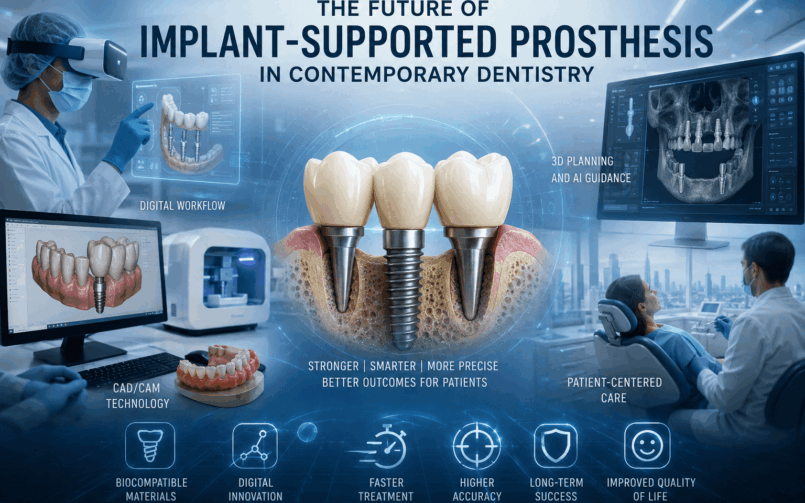
Implant-Supported Prosthesis in Contemporary Dentistry
Introduction
The replacement of missing teeth has always been a major objective in restorative dentistry. Conventional dentures and bridges have been used for decades; however, they often present limitations in terms of stability, comfort, function, and preservation of oral tissues. The introduction of dental implants has transformed prosthodontic rehabilitation by providing a fixed and biologically compatible foundation for prosthetic restorations.
Implant-supported prosthesis refers to dental prostheses that are supported and retained by osseointegrated dental implants placed within the jawbone. These restorations have become increasingly popular due to their superior esthetics, improved mastication, enhanced phonetics, and better patient comfort. Contemporary dentistry now relies heavily on implant prosthodontics as a predictable and long-term treatment modality.
Historical Background
The concept of osseointegration was introduced by Swedish orthopedic surgeon Per-Ingvar Brånemark in the 1960s. His discovery demonstrated the direct structural and functional connection between living bone and titanium implants. Since then, implant dentistry has evolved tremendously with improvements in surgical protocols, biomaterials, and digital technologies.
Types of Implant-Supported Prosthesis
1. Fixed Implant-Supported Prosthesis
Fixed prostheses are permanently attached to dental implants and cannot be removed by the patient. These include:
- Implant-supported crowns
- Implant-supported bridges
- Full-arch fixed prostheses
Advantages
- Superior stability and retention
- Improved chewing efficiency
- Enhanced esthetics
- Greater patient confidence
Disadvantages
- Higher cost
- Complex maintenance procedures
- Requires adequate bone support
2. Removable Implant-Supported Prosthesis
Removable implant prostheses, commonly known as overdentures, are supported by implants but can be removed by the patient for cleaning.
Advantages
- Better retention than conventional dentures
- Easier oral hygiene maintenance
- More economical than fixed restorations
Disadvantages
- May require periodic attachment replacement
- Slight movement may occur during function
Components of Implant Prosthesis
Dental Implant
The implant fixture is usually made of titanium due to its excellent biocompatibility and ability to osseointegrate with bone.
Abutment
The abutment connects the implant fixture to the prosthesis and plays an essential role in stability and esthetics.
Prosthetic Restoration
This includes crowns, bridges, or dentures fabricated using materials such as porcelain, zirconia, or acrylic resin.
Osseointegration
Osseointegration is the biological process in which bone forms a direct connection with the implant surface.
Successful osseointegration is critical for the long-term success of implant-supported prostheses. Factors affecting osseointegration include:
- Bone quality and quantity
- Surgical technique
- Implant design and surface characteristics
- Patient systemic health
- Oral hygiene maintenance
Contemporary Advances in Implant Prosthodontics
Digital Dentistry and CAD/CAM Technology
Modern implant dentistry increasingly utilizes digital workflows for diagnosis, treatment planning, and prosthesis fabrication. CAD/CAM technology allows highly accurate restorations with improved efficiency and precision.
Immediate Loading Implants
Immediate loading protocols enable prostheses to be attached shortly after implant placement, reducing treatment duration and improving patient satisfaction.
All-on-4 Concept
The All-on-4 technique uses four strategically placed implants to support a full-arch prosthesis, particularly beneficial for edentulous patients with limited bone volume.
Zirconia Prosthesis
Zirconia-based implant restorations provide excellent esthetics, biocompatibility, and strength, making them popular in modern restorative dentistry.
Advantages of Implant-Supported Prosthesis
Implant-supported prostheses offer several clinical and functional advantages:
- Preservation of alveolar bone
- Improved facial esthetics
- Enhanced speech and mastication
- Increased prosthesis stability
- Better patient comfort and confidence
- Long-term durability and success
Complications and Challenges
Biological Complications
- Peri-implant mucositis
- Peri-implantitis
- Bone loss around implants
Mechanical Complications
- Screw loosening
- Prosthesis fracture
- Abutment failure
Technical Challenges
- High treatment cost
- Need for precise treatment planning
- Requirement of multidisciplinary collaboration
Maintenance of Implant Prosthesis
Long-term success depends upon proper maintenance and patient compliance. Regular follow-up visits and oral hygiene instructions are essential.
Important maintenance measures include:
- Professional cleaning
- Plaque control
- Occlusal evaluation
- Radiographic assessment
- Periodic prosthetic adjustments
Future Perspectives
The future of implant prosthodontics is closely associated with digital innovation, artificial intelligence, 3D printing, and regenerative biomaterials. Personalized treatment planning and minimally invasive approaches are expected to further improve patient outcomes and accessibility.
Conclusion
Implant-supported prosthesis has become an integral component of contemporary dentistry due to its exceptional functional and esthetic outcomes. Advances in implant technology, digital workflows, and biomaterials continue to enhance the predictability and success of implant rehabilitation. Despite certain complications and financial considerations, implant-supported prostheses remain one of the most reliable treatment options for restoring oral function and patient quality of life.